ScanGO
ScanGO is an innovative IoT-powered attendance management solution that uses RFID (Radio Frequency Identification) technology to deliver fast, contactless, and highly accurate attendance tracking for modern campuses and organizations. Built…
Project Overview
ScanGO is an innovative IoT-powered attendance management solution that uses RFID (Radio Frequency Identification) technology to deliver fast, contactless, and highly accurate attendance tracking for modern campuses and organizations.
Built using Flutter for the mobile app and Next.js for the web portal, ScanGO enables seamless real-time attendance monitoring, secure access control, and centralized reporting — all through an elegant, responsive dashboard.
Students and staff simply tap their RFID cards to register attendance instantly. The system automatically syncs data with a centralized backend, empowering administrators with live analytics, movement logs, and powerful reporting tools.
ScanGO enhances operational efficiency and boosts campus security, making it an ideal solution for schools, colleges, universities, and corporate campuses.
Objectives
- Develop a fully contactless RFID-based attendance solution.
- Enable real-time synchronization between RFID devices, mobile apps, and backend systems.
- Strengthen campus safety by allowing access only to authorized RFID cardholders.
- Centralize attendance data for admin-level tracking, analytics, and reporting.
Key Features
RFID-Based Contactless Attendance
- Students and staff simply tap RFID cards to punch in/out.
- Ensures near 100% accuracy with instant data capture.
- Minimizes human error and eliminates manual entries.
Real-Time Entry & Exit Logs
- Tracks every movement with precise timestamps.
- Provides reliable reporting for audits and compliance.
- Enables administrators to monitor campus activity in real time.
Campus Access Control
- Restricts unauthorized access to campus zones.
- Easily integrates with RFID gate scanners and access points.
- Supports multi-role permissions for students, faculty, and staff.
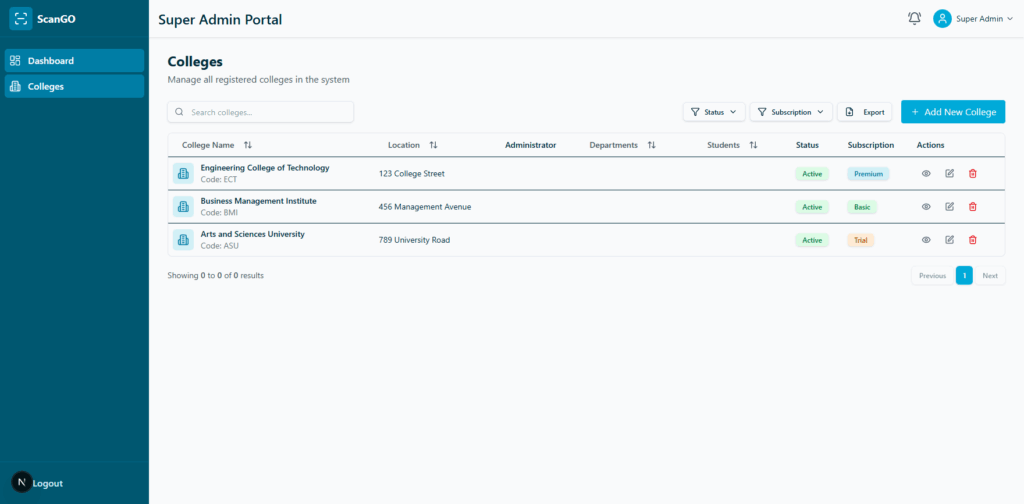
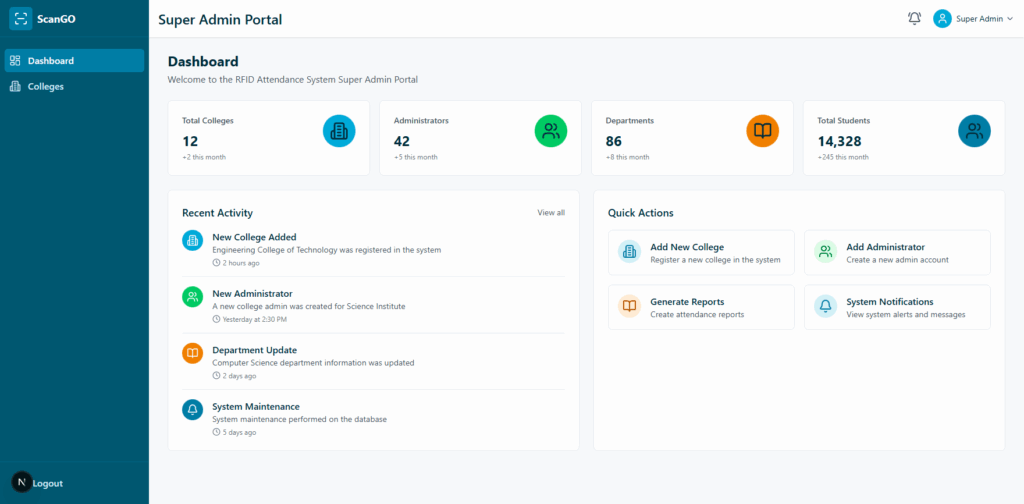
Centralized Web Dashboard
- Next.js-based admin portal for real-time decision-making.
- Live attendance monitoring, analytics, and detailed logs.
- Exportable reports (CSV/PDF) for administration and compliance.
Mobile App for On-the-Go Monitoring
- Flutter-based mobile app for Android and iOS.
- Real-time attendance visibility and notifications.
- Clean, intuitive, and responsive user interface.
Technology Stack
| Component | Technology Used |
|---|---|
| Mobile App | Flutter |
| Web Portal | Next.js |
| Backend | REST APIs / Cloud Integration |
| Database | Firebase / MongoDB / SQL |
| IoT Hardware | RFID Reader Integration |
| Hosting | Cloud Server |
| Authentication | Role-Based Secure Login |
Our Role
Our team designed, developed, and deployed the entire ScanGO ecosystem, including:
- Cross-platform Flutter mobile application.
- Next.js-powered web dashboard for administrators.
- Backend integration with RFID readers and real-time APIs.
- Database architecture, reporting tools, and analytics engine.
- End-to-end testing, deployment, and scalable infrastructure setup.
- Continuous support and maintenance for smooth operations.
Outcome
ScanGO transformed traditional attendance processes by delivering a fully automated, real-time, and secure digital system.
It replaced outdated manual methods with a modern IoT-driven platform that provides instant data access, transparent reporting, and enhanced campus security.
The solution now operates seamlessly across mobile and web, offering institutions a future-ready attendance system.
Impact Highlights
✅ Real-time RFID attendance with mobile & web synchronization
✅ Built using Flutter (mobile) and Next.js (web) for maximum flexibility
✅ Enhanced security through authorized RFID-based access control
✅ Centralized dashboards with exportable attendance reports
✅ Reduced administrative workload and improved operational efficiency
Conclusion
ScanGO demonstrates the powerful integration of IoT with modern mobile and web technologies.
With Flutter enabling mobile efficiency and Next.js delivering web scalability, ScanGO brings a smart, secure, and fully automated attendance solution to campuses and enterprises.
It is a future-ready platform designed to improve security, efficiency, and digital transformation across institutions.
Project Gallery